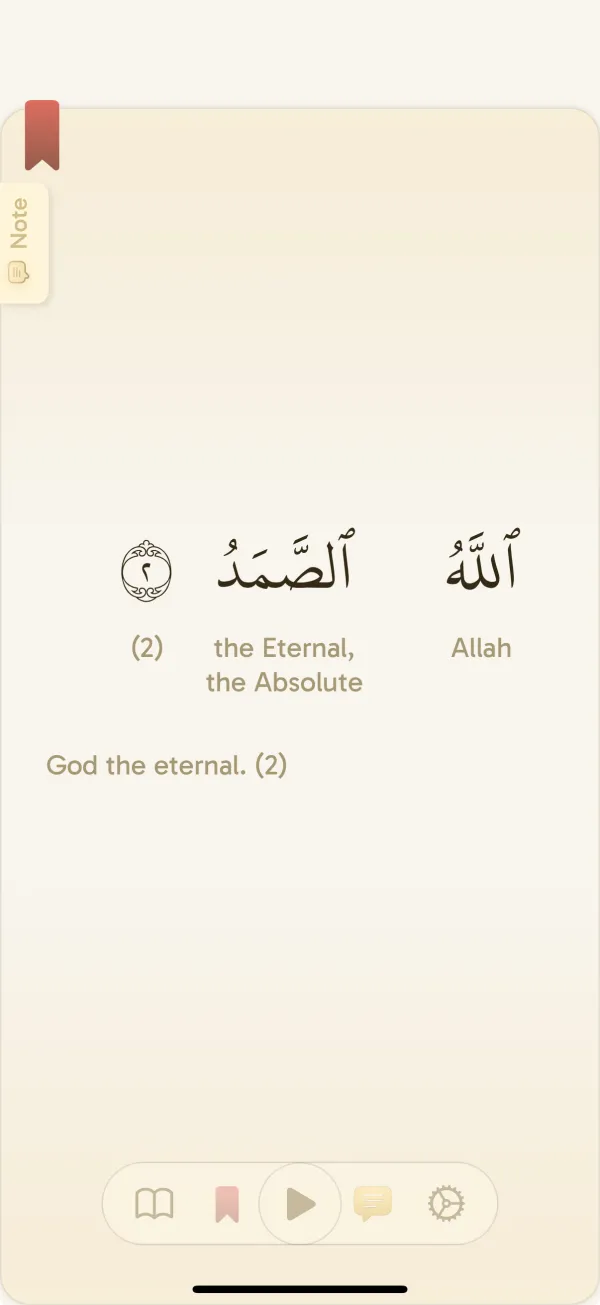
Begin with the whole passage
Read a short passage and its translation before collecting individual words. Keep the verse reference next to anything you study. A word-level gloss can help you follow the Arabic, while a full verse translation shows how the sentence is expressed as a whole. They serve different purposes.
Choose one to three words that you want to notice on your next reading. Picking a small set is a practical way to keep review short. If a word is difficult because of its form or the surrounding sentence, record the question rather than forcing it into a single English definition.
Use a read, recall, and check loop
This is a suggested practice sequence, not a guarantee of retention or fluency. You may need more encounters with some words, and recognizing a multiple-choice answer can feel easier than recalling the meaning without options.
- Find the Arabic word in the verse and check the displayed meaning. Listen to word audio if you need help connecting the written form to its sound.
- Look away from the meaning and try to recall it from the Arabic. If you are unsure, check again without treating the mistake as a failed session.
- Read the full verse translation again. Notice how the word works within that sentence rather than memorizing only an isolated label.
- Return to the same passage at your next session. Try to recognize the word before revealing the meaning, then continue reading.
Connect Yawm practice to what you just read
In Yawm, enable word-by-word meanings in the reader and tap a word to explore its details. Finish a short reading session, then open Vocabulary to practice words connected to that reading. You can also return to recent reading sessions in Journey to revisit their activities.
Use matching games, multiple-choice questions, audio questions, and recall practice to revisit the words in different ways. Spaced repetition brings words back for review, and quiz progress makes a short session feel tangible. Then return to the passage and check whether you recognize the word in context.
Vocabulary quiz meanings currently use English. Changing Yawm’s interface language does not translate the quiz content into every supported language. An internet connection is needed to start a quiz and save its results, so plan this part of the routine for when you are connected.
A simple first week
Repeat words when you need to rather than filling every session with new ones. If review consumes the whole session, add fewer words next time. You can also use a reading-only day and return to quizzes later.
Swipe or scroll to compare.
| Session | What to do | What to keep |
|---|---|---|
| First reading | Choose a short passage; check its translation; select a few words | Verse references and the forms you actually saw |
| Next reading | Try recalling yesterday’s words before checking; continue the passage | One question or word that still needs another look |
| Later in the week | Revisit an earlier passage without opening every word meaning immediately | A realistic sense of which words you recognize in context |
Keep vocabulary progress separate from full understanding
Recognizing a word is one part of learning Arabic. Sentence structure, word forms, context, and interpretation still matter. Keep using complete translations and tafsir for context, and bring language questions to a suitable Arabic course or teacher when you want more structured study.
We do not use a word-count percentage as a promise that you will understand the Quran after learning a fixed list. Frequency counts depend on what is counted, and recognizing common words does not by itself show that a reader understands a sentence. A more concrete personal check is whether you can recognize your studied word in a passage and explain what you still need to learn.
Common questions
Can I learn Quranic vocabulary while reading Quran?
Yes. You can study a few words from a short passage, check their meanings, then revisit the passage and try to recognize them. Yawm connects optional vocabulary practice to reading sessions to support that routine.
Does memorizing common Quran words mean I understand the Quran?
Recognizing common words can support study, but it does not establish full comprehension. Word forms, grammar, context, translation, and tafsir still matter. This guide makes no numeric comprehension promise.
Which language does Yawm use for vocabulary quizzes?
Vocabulary quizzes currently use English meanings. Other app interface languages and downloadable reader translations do not imply that quizzes use those same languages.